
Comment le bon crochet a amélioré la sécurité des crochets de grue dans une fonderie
In heavy industrial environments, small component failures can quickly become major safety hazards. This is especially true inside foundries, where overhead cranes continuously move molten metal, steel castings, and high-temperature materials through demanding production cycles.Crane hook safety is one of the most critical concerns in foundry crane operations.
One of the most overlooked yet critical crane components is the hook. While many operators focus on motors, wheels, and wire ropes, the crane hook directly carries the load and plays a central role in operational safety.
This article shares how one foundry operation solved recurring safety issues simply by selecting the correct crane hook configuration. The case demonstrates why proper hook design, material selection, heat treatment, and inspection standards matter in high-duty applications.
Au HL CRANE, we regularly work with steel plants, foundries, and heavy industries to provide reliable crane parts for severe working conditions.
The Safety Problems Inside the Foundry
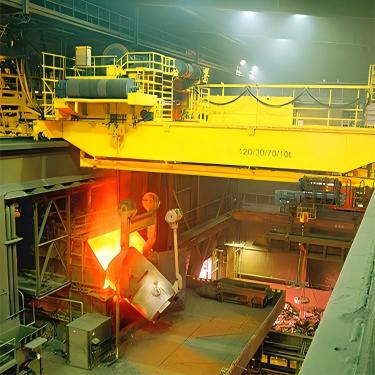
The customer operated a medium-sized steel casting foundry using double girder overhead cranes for handling ladles and heavy cast components. The crane worked under continuous high temperatures, dust exposure, and frequent load cycles.
Initially, the foundry experienced several recurring problems:
- Excessive hook throat opening deformation
- Surface cracks near the hook saddle
- Frequent wire rope twisting during lifting
- Unstable load positioning
- Increased downtime for inspections and repairs
- Operator concerns regarding lifting safety
Although none of these issues caused a serious accident, the maintenance team understood the risks involved. In foundry environments, even a small lifting failure can lead to catastrophic consequences involving personnel safety, equipment damage, and production shutdowns.
The original hook assembly was designed for general industrial lifting rather than high-temperature foundry operations. After years of heavy-duty service, the hook material and structural design no longer matched the application requirements.
Why Crane Hooks Fail in Foundry Applications
Foundries create one of the harshest environments for overhead crane systems. Several factors accelerate crane hook wear and fatigue:
1. High Temperature Exposure
Continuous exposure to radiant heat affects the mechanical properties of standard hook materials. Lower-grade steel hooks may gradually lose strength and toughness under elevated temperatures.
2. Heavy Dynamic Loading
Foundry cranes rarely operate under stable static loads. Sudden starts, stops, and load swings generate dynamic forces that significantly increase hook stress.
3. High Working Duty Cycles
Most foundry cranes operate under A7 or A8 duty classifications, meaning the hook experiences thousands of repetitive stress cycles every month.
4. Dust and Contamination
Metal particles, abrasive dust, and scale contamination accelerate wear on hook blocks, bearings, and rotating assemblies.
5. Improper Hook Selection
Many facilities choose hooks based only on lifting capacity while ignoring:
- Working temperature
- Fatigue resistance
- Rotation requirements
- Impact loads
- Heat treatment standards
- Inspection accessibility
This often leads to premature failures.
The Investigation Process
The maintenance engineers performed a full inspection of the crane lifting system. Several issues were identified:
- The hook material lacked sufficient fatigue resistance
- The hook saddle showed uneven stress concentration
- The existing hook design allowed excessive load rotation
- Heat treatment hardness was inconsistent
- The hook block bearings suffered from poor sealing performance
The engineering team decided to replace the entire hook assembly rather than continue repeated repairs.
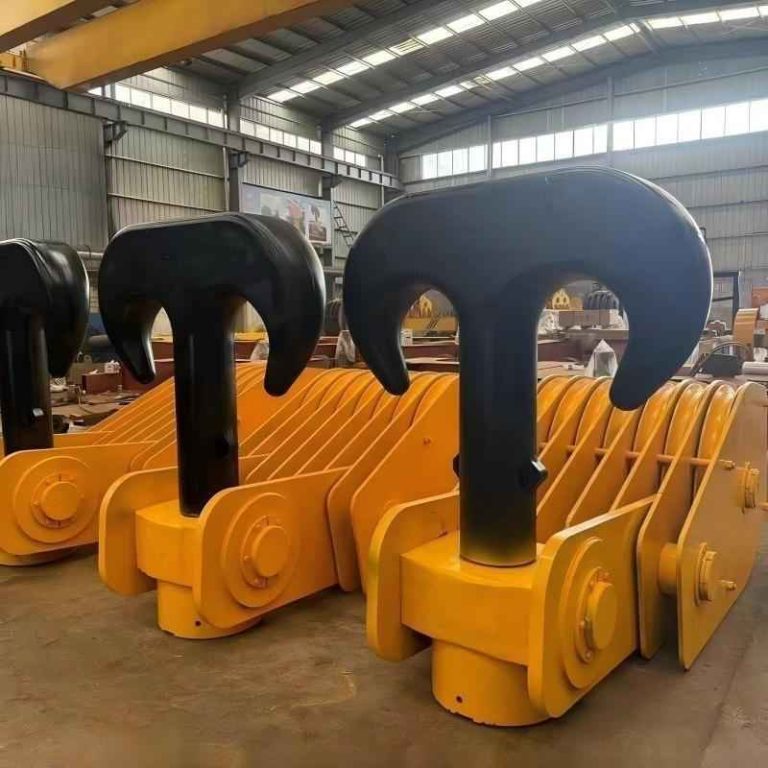
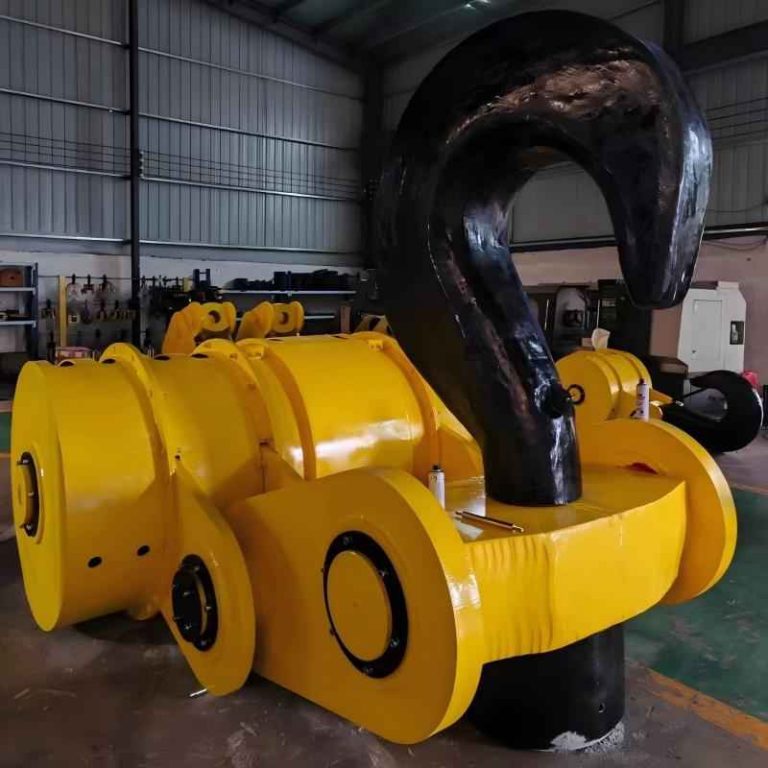
Instead of purchasing a standard replacement, they selected a heavy-duty forged hook specifically designed for foundry crane applications.
Choosing the Right Hook Solution
After evaluating the operating conditions, the foundry upgraded to a custom forged hook assembly with the following features:
Forged 42CrMo Alloy Steel Material
Compared with ordinary carbon steel hooks, forged 42CrMo offered:
- Higher tensile strength
- Better impact resistance
- Improved fatigue performance
- Better resistance to thermal stress
The forging process also reduced internal defects and improved structural integrity.
Optimized Heat Treatment
The new hook underwent complete quenching and tempering treatment to achieve balanced hardness and toughness.
Proper heat treatment is critical because:
- Excessively hard hooks become brittle
- Soft hooks deform under heavy loads
- Uneven hardness creates stress concentration points
The new design achieved stable mechanical properties suitable for continuous foundry operation.
Enlarged Hook Saddle Radius
One important improvement involved redesigning the hook saddle geometry.
A larger saddle radius reduced localized wire rope stress and improved rope alignment during lifting. This helped minimize twisting and uneven rope wear.
As a result:
- Wire rope service life increased
- Load stability improved
- Shock loading decreased
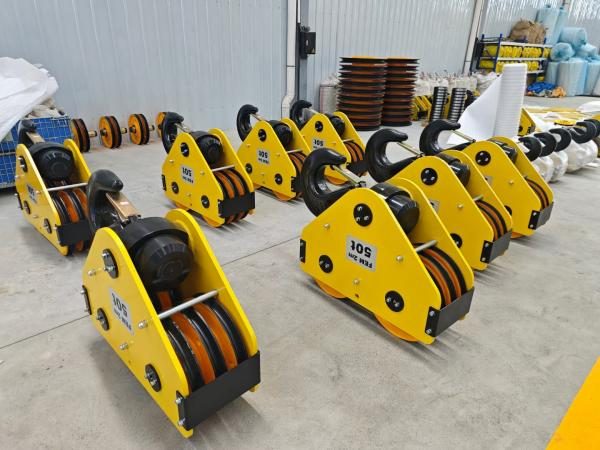
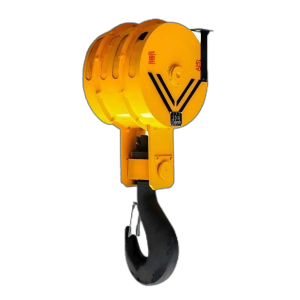
Heavy-Duty Rotating Hook Block
The original hook rotation system frequently jammed due to dust contamination.
The upgraded hook block included:
- Sealed bearings
- Improved lubrication channels
- Heat-resistant protective covers
- Better dust protection design
The rotating mechanism became smoother and more reliable during continuous operation.
Non-Destructive Testing and Certification
Before installation, the new forged hook passed:
- Essais par ultrasons (UT)
- Magnetic particle inspection (MT)
- Tests de charge
- Contrôle dimensionnel
These tests ensured there were no internal cracks or forging defects.
The foundry also established a regular inspection schedule according to crane safety standards recommended by organizations such as OSHA et ASME.
The Results After the Upgrade
Within six months of operation, the foundry reported significant improvements.
Improved Operational Safety
Operators noticed immediate improvements in lifting stability and hook rotation performance. Safety concerns during molten metal handling were greatly reduced.
Reduced Maintenance Downtime
The maintenance department recorded fewer unscheduled shutdowns related to hook inspections and repairs.
Longer Service Life
The forged heavy-duty hook demonstrated much better wear resistance compared to the previous standard hook.
Lower Long-Term Costs
Although the upgraded hook cost more initially, the reduction in downtime and maintenance produced lower overall operating costs.
Important Lessons for Crane Operators
This project highlighted several important lessons for industrial crane users.
Do Not Choose Hooks by Capacity Alone
Two hooks with the same lifting capacity may perform very differently depending on:
- Qualité du matériau
- Forging quality
- Traitement thermique
- Duty classification
- Operating temperature
Always match the hook design to the actual working environment.
Foundry Applications Require Specialized Components
Foundry cranes face extreme conditions that ordinary crane parts cannot always handle reliably.
Critical components such as:
- Crochets
- Roues
- Batterie
- Poulies
- Accouplements
should be selected specifically for high-duty applications.
For example, using forged crane wheels with proper heat treatment can significantly reduce wheel wear in steel plant operations. Related solutions can be found on the HL CRANE official website.
Regular Inspection Remains Essential
Even the best hook requires routine inspection.
Operators should regularly check for:
- Hook throat opening changes
- Surface cracks
- Excessive wear
- Bearing looseness
- Rotation abnormalities
- Heat damage
Early detection prevents serious failures.
Why Forged Hooks Are Preferred in Heavy Industry
Forged hooks remain the preferred solution in heavy-duty industries because forging improves metal grain flow and structural strength.
Compared with cast hooks, forged hooks generally provide:
- Better fatigue resistance
- Higher reliability
- Improved impact toughness
- Longer service life
This makes forged hooks especially suitable for:
- Fonderies
- Steel mills
- Port cranes
- Mining cranes
- Heavy fabrication plants
Selecting a Reliable Crane Hook Manufacturer
Choosing the right manufacturer is just as important as selecting the right hook design.
A professional crane hook manufacturer should provide:
- Material traceability
- Dossiers de traitement thermique
- Non-destructive testing reports
- Load testing documentation
- Application engineering support
Au HL CRANE, we manufacture heavy-duty crane parts for demanding industrial applications, including foundries, steel plants, and port handling systems. Our products are designed to meet the reliability requirements of high-duty crane operations.
Conclusion
The foundry’s safety problems were not caused by operator error or crane overload. The real issue was improper hook selection for a severe working environment.
By upgrading to a properly engineered forged hook assembly, the company achieved:
- Better lifting safety
- Reduced maintenance downtime
- Longer component life
- Improved operational reliability
This case demonstrates an important principle in industrial lifting: selecting the correct crane component is not simply about capacity — it is about matching the equipment to the real operating conditions.
For heavy-duty foundry cranes, investing in the right hook is ultimately an investment in safety, productivity, and long-term operational stability.
FAQ
1. Why is crane hook safety important in foundry operations?
Crane hook safety is critical in foundries because overhead cranes frequently handle molten metal, heavy castings, and high-temperature materials. A damaged or improperly selected hook can lead to load instability, equipment failure, production downtime, or serious safety accidents. Using a properly forged and heat-treated crane hook helps improve lifting reliability and operator safety.
2. What type of crane hook is best for heavy-duty foundry cranes?
Forged alloy steel hooks, especially those made from materials like 42CrMo, are commonly recommended for heavy-duty foundry cranes. These hooks offer higher strength, better fatigue resistance, and improved impact performance compared to ordinary carbon steel hooks. Proper heat treatment and non-destructive testing are also essential for long-term reliability.
3. À quelle fréquence les crochets de grue doivent-ils être inspectés ?
Crane hooks should be inspected regularly based on crane duty classification and operating conditions. In foundry and steel plant environments, daily visual checks and scheduled detailed inspections are highly recommended. Operators should monitor for hook throat opening deformation, cracks, excessive wear, bearing looseness, and abnormal rotation to maintain crane hook safety and prevent unexpected failures.