
Cross-Reference Guide: Chinese Crane Parts vs Global OEM Brands
In today’s global crane maintenance market, sourcing replacement parts is no longer limited to the original manufacturer. Many crane owners and maintenance companies are now exploring alternative supply channels — especially from China — to reduce downtime and control costs.
However, one key concern always arises:
Can Chinese crane parts truly replace OEM components from global brands?
Based on our experience at HL CRANE, the answer is yes — but only when the cross-referencing process is done correctly.
This guide explains how crane parts manufactured in China can match, replace, or even outperform OEM parts from international brands when technical compatibility is properly verified.
Why Cross-Referencing Matters
Unlike automotive parts, crane components are rarely standardized across manufacturers.
Even when two cranes have the same lifting capacity, their:
-
Hook dimensions
-
Pulley groove profiles
-
Wheel hardness
-
Drum flange design
may differ significantly.
This is why simply quoting a part number is often not enough.
For example:
A crane pulley used on a European system may look identical to one used in an Asian-built crane — yet:
-
Rope groove angle
-
Bearing seat tolerance
-
Load rating
can vary.
Without technical verification, direct substitution can cause:
-
Rope wear
-
Load imbalance
-
Premature failure
That’s why professional cross-referencing focuses on engineering parameters, not just brand names.
Common OEM Brands vs Chinese Alternatives
In real projects, we often see replacement demand involving brands such as:
-
Konecranes
-
Demag
-
Terex
-
Liebherr
-
Tadano
These manufacturers produce highly reliable equipment, but OEM spare parts often come with:
-
Long delivery times
-
High pricing
-
Limited regional stock
This is where Chinese manufacturing fills the gap.
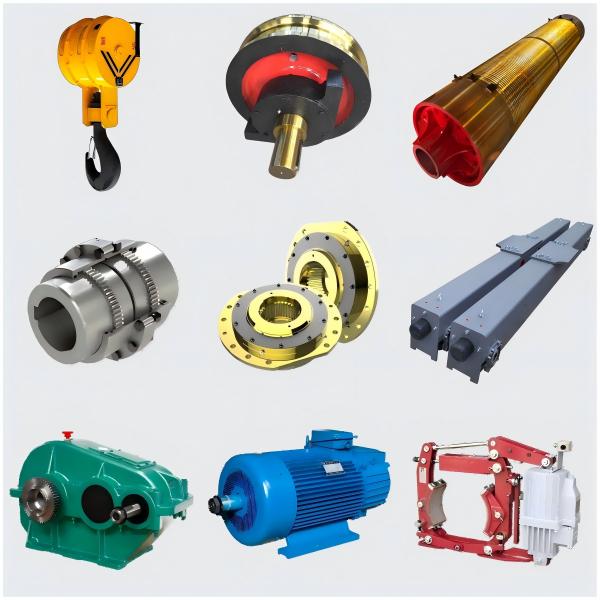
Companies like HL CRANE specialize in producing:
-
Crane hooks
-
Wire rope drums
-
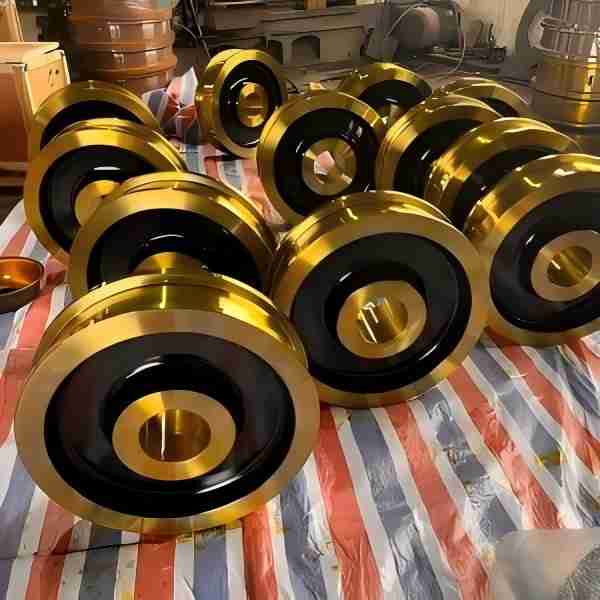
Crane wheels
-
Sheaves & pulley blocks
that are built according to supplied drawings or measured samples.
👉 Learn more about our pulley solutions:
https://www.hnhlcrane.com/product/overhead-crane-pulley/
Which Parts Are Safest to Cross-Reference?
Not all crane components carry the same level of replacement risk.
Low-Risk Replacement Parts
These are commonly replaced with Chinese equivalents:
-
Crane wheels
-
Rope drums
-
Hooks
-
Couplings
Because their performance depends mainly on:
-
Material grade
-
Heat treatment
-
Machining accuracy
Rather than brand-specific design logic.
👉 Example:
https://www.hnhlcrane.com/products/crane-wheel/
Medium-Risk Parts
Require drawing verification:
-
Pulley blocks
-
Gear couplings
-
Brake wheels
These must match:
-
Mounting interface
-
Load rating
-
Rope compatibility
Without drawings, reverse measurement may be required.
High-Risk Parts
Usually should stay OEM unless full engineering data exists:
-
Electrical systems
-
Load limiters
-
Control modules
Mechanical parts are easier to cross-match than intelligent systems.
Cost vs Reliability: The Real Balance
Many buyers assume choosing Chinese parts means sacrificing reliability.
But in reality, the performance of a crane component depends more on:
-
Material selection
-
Heat treatment
-
Quality control
than brand origin.
For example:
A properly forged 42CrMo hook manufactured under controlled conditions will perform as reliably as many OEM hooks — at a fraction of the cost.
👉 See our hook manufacturing process:
https://www.hnhlcrane.com/products/crane_hook/
When OEM Still Makes Sense
There are situations where sourcing from the original manufacturer is still the best option:
-
When drawings are unavailable
-
When proprietary geometry exists
-
When safety certification requires OEM traceability
In fact, we often advise clients:
“If technical drawings cannot be provided, sourcing from the original supplier is safer.”
This applies especially to complex pulley systems or unique assemblies.
The Future of Global Crane Parts Supply
The crane industry is moving toward a hybrid sourcing model:
OEM remains critical for:
-
System integrity
-
Electronic components
-
Specialized assemblies
While independent manufacturers like HL CRANE support:
-
Mechanical spare parts
-
Wear components
-
Custom fabrication
This balance allows operators to:
-
Reduce maintenance costs
-
Shorten downtime
-
Maintain operational safety
Conclusion
Cross-referencing Chinese crane parts with global OEM brands is no longer a risky shortcut — it is a strategic maintenance decision.
When backed by:
-
Accurate drawings
-
Material verification
-
Load testing
Chinese-manufactured components can provide a reliable and cost-effective alternative to original parts.
At HL CRANE, our role is not simply to supply parts — but to ensure compatibility.
Because in lifting equipment, precision matters more than brand names.
External Reference
For general industry standards related to crane safety and component performance, buyers can refer to:
https://www.iso.org/standard/66927.html
FAQ – Chinese Crane Parts vs OEM Brands
1. Can Chinese crane parts directly replace OEM components?
Yes — but only when technical parameters are verified.
Replacement should be based on:
-
Load capacity
-
Material grade
-
Dimensions
-
Installation interface
Not just part numbers.
When drawings or samples are available, Chinese manufacturers like HL CRANE can produce fully compatible mechanical parts such as hooks, wheels, and drums.
2. Which crane components are easiest to replace with Chinese alternatives?
The safest parts to replace include:
-
Crane hooks
-
Crane wheels
-
Rope drums
-
Couplings
These components rely more on material quality and machining accuracy than proprietary design.
More complex assemblies like pulley systems may require drawings before replacement is possible.
3. Will using non-OEM crane parts affect safety?
Not if the replacement is properly engineered.
A well-manufactured component using certified materials (such as 42CrMo or forged alloy steel) can perform just as reliably as OEM parts.
Safety depends on:
-
Design accuracy
-
Heat treatment
-
Quality control
—not brand origin.
4. When should I buy directly from the original crane manufacturer?
OEM sourcing is recommended when:
-
No technical drawings are available
-
The component has proprietary geometry
-
Certification requires OEM traceability
-
The part involves electrical or control systems
In these cases, replacing with alternatives may introduce risk.
5. How do I confirm compatibility before ordering replacement crane parts?
The best approach is to provide one of the following:
-
Original technical drawings
-
Part dimensions
-
Photos with measurements
-
Worn sample parts
This allows manufacturers like HL CRANE to reverse-engineer and verify load compatibility before production.